Sunday, 11 June 2017

Rodeo to Chile Cito

Walking along 'the windiest lake in Argentina',
or so they say...

Following the river down to Jachal
Fidgit and I spent a day in Rodeo to work before setting off again. We left as the wind whipped around us in the valley. We walked along the reservoir outside of town and then into the narrow valley that would connect us to the next town. A policeman had warned Fidgit about this stretch of road being very narrow and dangerous, so we were cautious as we wound along the riverside and down. The road was indeed narrow and winding, but every vehicle was being careful along it and most honked encouragement. We spent the night along the river, and in the morning hours, the valley opened up for us. We arrived in the next town shortly after lunch and parked ourselves in the corner of the YPF - an Argentine gas station chain that usually has wifi. It got to be late quickly, and since we still needed to resupply, we decided to stay the night in town. The plan was to resupply and head out the next morning.

It was a good thing we decided to stay, because nearly as soon as we found a place, I was hit with a bout of intestinal distress. Grateful for a bed, I zonked out that night. In the morning, I wasn't feeling much better, and everything was closed because it was Easter Sunday, so we ended up staying for longer in the town of Jachal. Again, I was grateful because even though my intestines weren't cooperating, the weather outside was cold, cloudy and rainy.

Sunrise along the way
The dam looks small, really the
canyon is just big
My intestines and the weather cleared up around the same time, and we were able to continue our journey. We walked on, into some beautiful mountains for a day before coming out and making our way onto Ruta Nacional 40. Getting onto Ruta 40 is something I've been hearing about for so long and we are finally there! I was concerned it would be a very busy road. As it turned out, Ruta 40 is a 2-lane highway in a rural area, so the traffic was more, though not enough to endanger us.

Right as we made it to Ruta 40, a young man on a bike came up behind us. He was a Scotsman and had been out for about three months, making his way north. He was going to stop along the Ruta and attempt to get a ride further north. We said our goodbyes and made our way along, enjoying the warm weather until it got too hot; then we made our way to the shade of a nearby tree. As we were semi-dozing waiting for the evening to cool off, the Scotsman, Peter, rolled by again. We talked for a bit before deciding to camp together nearby. We set up camp and chatted for a good while before bed. Fidgit and I figured out that this was only the third time that someone had camped with us on-trail this season, and I very much enjoyed talking bike gear with him that evening.

Scenery along the route
Looking out from a look out


Fidgit and I parted ways with Peter the next morning, as walking is much slower than biking. Making our way towards the small town of Santa Clara, we were able to get some water from some construction workers. We were running low in the afternoon, so Fidgit hung her trusty 'AGUA' sign from her backpack once more. I am thankful these dry stretches have been along traveled roads so we don't have to carry more than two days of water at a time. We flew the sign as our water dwindled, and we pushed for a big kilometer-age day.

As early evening settled in, two people stopped in quick succession. One car stopped and turned around to give us water, smiling and wishing us luck. The other vehicle that stopped was a truck marked 'explosives' on the back - the driver got out and put water and snacks on the side of the road, telling Fidgit that he had seen us on his way past earlier. Water AND snacks?! What amazing people inhabit this earth! Boosted again by the kindness of strangers, I was able to walk a bit into the night to complete our first 40 kilometer day this season. It also happened to be day 300 of our entire trip, so there was a lot to celebrate. I celebrated by eating dinner and falling fast asleep.

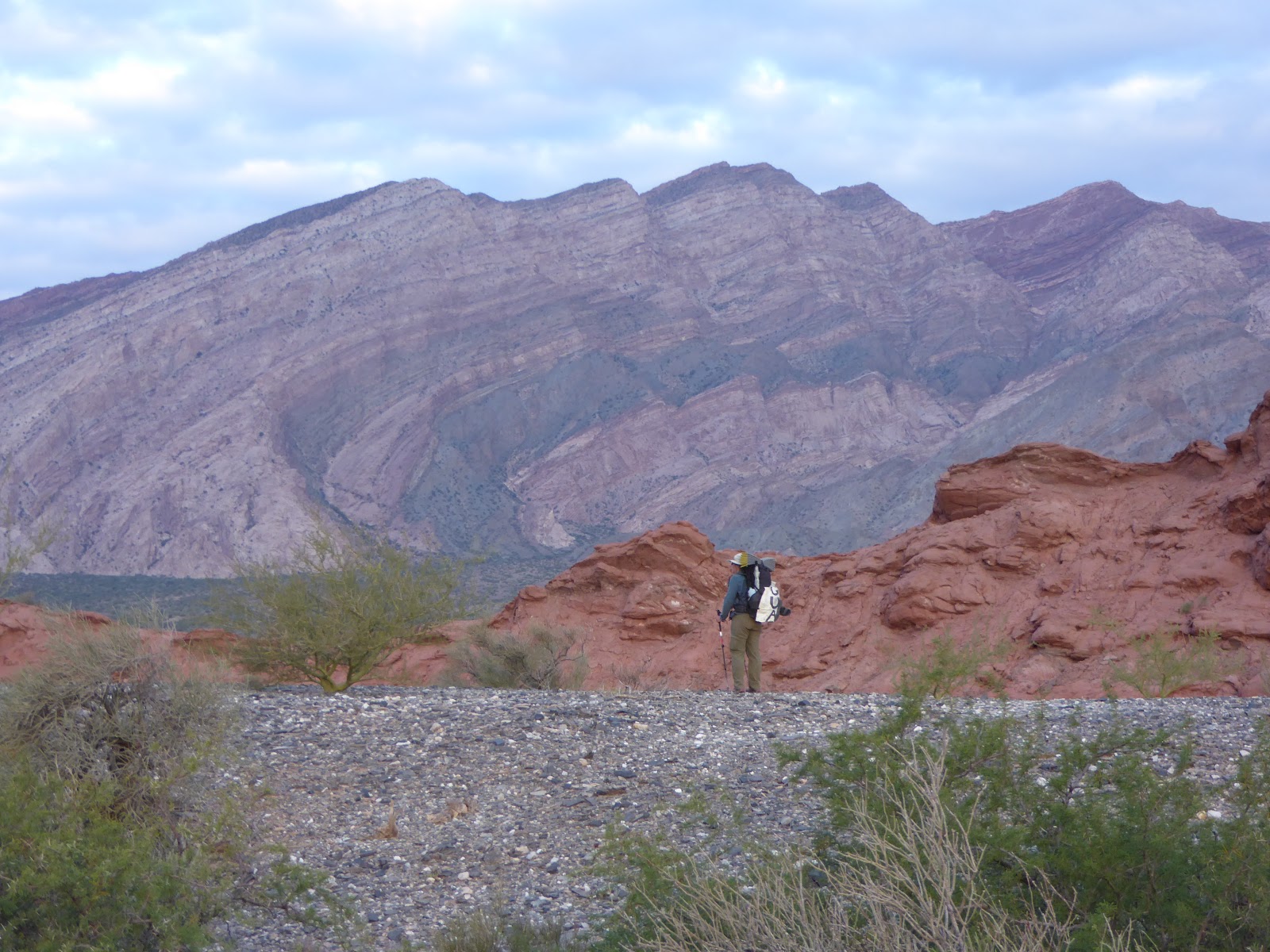
I was relieved not to be sore the next morning, and we walked into and through the small pueblo of Santa Clara quickly. We stopped in the nearby YPF for a bit, then walked on after loading up on water for the next 40 kilometers. On our way towards Villa Union, we passed between some mountains that I had been watching get closer for a few days. The red rocks and sandstone had me frequently thinking of my home in Utah. It is amazing how places so far from each other can look so similar.

We made a friend and he camped with us for the night!
Peter is a biking Scotman, and spent a night in the
desert with us.
We camped in a wash, out of view from the vehicles passing, and enjoyed a cooler evening among the red rocks. In the morning, we watched the rocks light up as the sun rose, before we walked on into Villa Union which was having a power outage. It was the second power outage we had heard of this section, and it didn't seem like an unusual thing, so we'll see if it continues. The power was back on within a couple of hours, so Fidgit and I were able to find a place to stay for the night. Tired from a full day of walking and being exposed to the sun, I showered and fell into a deep sleep quickly after.

Dinner time!


We left Villa Union and again walked into a chunk of mountains after crossing the valley floor for half a day. It seems around here the only place that water stays is in the mountains. The rest of our walking is quite arid. In the elevation and terrain change, we found a cool wash to follow instead of the road. We were so happy to be not along the road, and plunged in head first. Fidgit found some quicksand, so we were more careful after that, but to be immersed back in nature among the sandstone and dirt was reinvigorating.


We found our way back onto the road in the morning, and went up to a 2,000 meter pass and then down into the valley that held the small town of Sanogasta. At our lunch break, we figured out that we could get into town that evening, resupply and camp somewhere north of town. So that's exactly what we did, and as a result, ended up doing another 40 kilometer day. We also found our way through the unofficial town dump before camping nearby. I laid my weary body down and was soon fast asleep.
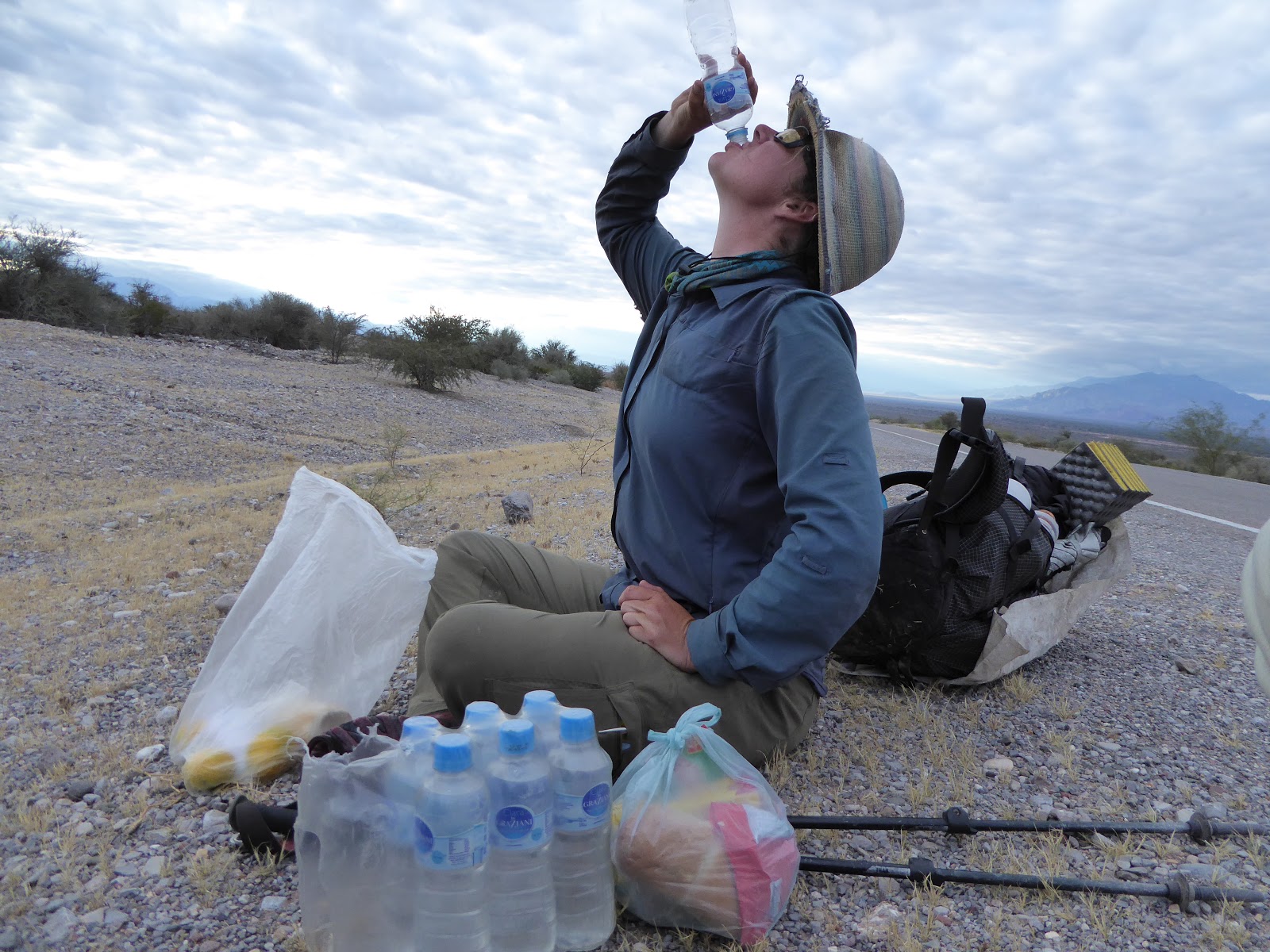
Trail magic of water and snacks!
We awoke the next morning to soaked sleeping bags and threw them over our packs to dry in the morning air as we walked. With road walking, we don't have to be as concerned with our bags snagging on branches and tearing as they dry. The cool morning warmed up quickly as we made our way to another mountain pass. Thankfully as we crested the pass, a breeze came up and cooled us for the walk down to the largest town we've seen in a while - Chilecito.


We meandered into town late afternoon and weary from the sun exposure as well as a 30 kilometer (so far) day. After walking a few kilometers into the center of town, we found a small hostel and posted up for the night. We left town the next day after properly filling up on empanadas.

Pack it in, Pack it out also applies to trail magic
Got water?

A small band of parrots can make a surprising amount of noise

Fidgit and the wavy mountain

Sunday, 4 June 2017

Barreal to Rodeo

Fidgit getting water north of Barreal
In Barreal, we were looking for internet and ended up on the front porch of a hostel. The hostel was closed for the season, but the owner kindly gave us his wifi password and some water. We sat on the porch for a few hours, catching up with business stuff before we decided to ask if we would be able to stay for the night. The owner, Maoro, said yes and showed us a room. As he was showing Fidgit around, it turns out that another person who was on an endeavor to walk from Ushuaia to Alaska stopped through here ten years ago. His name was Ian and he spent a month in Barreal!

I checked a water source with my feet and found oil
in the mud near Calingasta
We were able to do all of our town chores in a day and made our way out of Barreal the next morning, walking towards Calingasta. Having so many town stops along our route has made resupplies easier because we only need food for a few days at most. The thing that is most concerning for us is the stretches between towns that don't have any water.

We made it to Calingasta in a couple of days, with minimal concerns for water because we were walking along a valley floor with a river flowing to our east. In Calingasta, we were able to quickly resupply and left town in a blowing wind, which is common along the anteplano down here, and we have had the luck of not experiencing much thus far.  We had a sidewind, and then a tailwind, pushing us forward to where we finally camped - in some shrubs next to a schoolhouse protected from the winds howling around us. I slept fitfully that night, until the winds died down and the near-full moon set.

Enjoying the view in the distance.
Road walking
The next morning, the day was calm and cloudy- perfect for walking. We packed up and walked through two small 'villas' of a few houses each. At the last villa, we also reached our last water source for what we believed to be 90 kilometers. We decided to nap by the water and head out later in the evening after making dinner to save on water consumption. Also, the full moon would be enjoyable and help light our way through the desert. I'm not generally a night owl, but I was up for trying to night hike, and the sun has been setting around 7:30, so it how bad could it be? We ate dinner and left the small villa with high hopes and 8+ liters of water on our backs. I tried for a few hours to enjoy hiking in the light of the full moon, and I believe I failed miserably. I struggled to put one foot in front of the other, I blamed it on the cold wind, the extra 17 pounds on my back, and that I couldn't nap when we tried earlier in the day. In the end, maybe I'm just not a night hiker. We found a flat spot along the dirt road and passed out around 11 pm.


We found some shade under this sign
I slept horribly, and woke up to a cold morning and a hiking partner who also slept poorly. We ambled on, trying to be positive until the sun warmed our bones so much we shed our layers and enjoyed the slight breeze that came up. We saw that Fidgit had marked an abandoned estancia along our route and planned to make it the 35 km there. As we closed in on our goal, we noticed it didn't look as abandoned as it perhaps once was. We came upon the 'abandoned estancia' and walked up to a Gendarmeria, where there were warmly greeted by one of the four men stationed there. They invited us in, shared their fire and dinner with us, and set up mattresses in front of the fireplace for us to sleep on. Many stories were shared, but I was mostly deliriously tired and struggling to sit upright, so I didn't have much capacity for much else.


A full moon rises near the Gendarmeria
We both slept well that night, and left the next morning refreshed and headed downhill into town, knowing we would have enough water to get there. We made it down to the small town of Bella Vista and decided to stealth camp in an abandoned lot and walk into the larger town of Rodeo the next day. We found a small lot full of prickly shrubs and situated ourselves in for the night. We awoke the next morning to cool temperatures and made our way to a gas station to warm up and get some internetting done - we have recently figured out that the YPFs of Argentina have some of the best internet around!

The men of the remote Gendarmeria and us

At the gas station, we ran into a guy from Minnesota working on his Masters Thesis. He was also volunteering at a nearby National Park, and we talked with him more than we got things accomplished. It's been a while since I've spoken in person to a native English speaker, and I realized through speaking with him how much I'd simplified my language and forgotten words. As Fidgit and I left the gas station to make it to Rodeo, we made plans with our new friend Andy to meet up later for dinner. We then busted our butts to walk the 15 kilometers to Rodeo before nightfall, and we made it just in time! Unfortunately, Andy's ride picked him up super late, and we were unable to have dinner together. Fidgit and I found a place to stay in Rodeo, then promptly showered and collapsed into our beds.

Dirt road walking- our longest dry stretch

Sunday, 21 May 2017

Tupungato to Barreal

Sole and Susana drove us from Mendoza to Tupungato, and we said a teary farewell in the village square, snapping one more photo of all four of us before Fidgit and I made our way down the street. As we left, we realized it was quite late in the day and the sun was beginning to set. Knowing we wouldn't make it out of town enough to find a decent place to set up our tent, we walked into a nearby hotel and got a cheap room for the night, breakfast included. Fidgit met a woman as we were checking in who was very interested in our project and asked us to come onto her radio show the next morning to talk about Her Odyssey. We went to bed with butterflies in our stomachs that night.

The next morning, we checked out of the hotel, had some breakfast and were taken to the local radio station, where Fidgit did most of the talking - the norm for us, since her Spanish is far better than my own. We left town late in the morning, grateful for kind and supportive people and really happy to be walking again. The day was warm with a lot of humidity and clouds looming in the distance. As we walked, our legs stretched and my mind wandered. Road walking is a different being to me than trail walking (or, sometimes, bush-whacking). When road walking, you can see very well where you are going and all you have to watch out for is vehicles and bicycles. It can be mundane, though it can also allow you to process through thoughts and ideas more thoroughly. I enjoy being able to space out and not have to worry about mis-stepping or getting lost.


As the day wore on, the clouds began looming closer and closer, until we were being rained on. Lightly at first, then as we neared a small building, the downpour began. We knocked on the doors of the building, which turned out to be a small clinic, though at first no one answered. The downpour became a deluge, so we knocked harder and tried the door knobs to see if any were unlocked. Finally, an older gentleman came to one of the doors and guided us into the waiting room of the clinic, where we stood dripping water for a few minutes until the gentleman and his wife invited us back to their living quarters. It turns out we had woken them up from their siesta and surprised them. Fidgit and I apologized, though they said 'no problem,' and we talked and drank mate the rest of the evening as the storm raged outside. Cristina and Antonio ended up offering us a bed for the night and building up a fire so we could dry out our soaked clothing.

In the morning, the rain had dissipated, so we packed up, said our goodbyes, and walked on, with the added weight of a few gifts from the couple. We didn't feel weighed down, as the overcast sky and cooler breeze made for excellent walking weather. Before we knew it, we were 10 km from Portrerillos at 5 p.m. We talked over whether we should camp outside of town, or push in and meet up with a connection we had there. We both decided we wanted to push in. Our feet nearly revolted, but we made it into town just after dark and met Alejandra and her husband at their house.

They warmly greeted us and showed us a room that we could stay in, then left us to shower before dinner. We all had dinner together and talked about many things. I enjoy being in the presence of like-minded, adventurous people, and over the next day we had many thoughtful discussions. Fidgit and I learned that the couple (Alejandra and Koky) had begun their business almost by accident, fixing worn out PFDs, and now they make many of the PFDs sold in Argentina. We would have liked to stay longer, but we had made plans to meet out friend Pablo (from Mendoza) near Uspallata, 40+ kilometers down the road.

We walked out of Portrerillos late in the morning to walk along the abandoned Ferrocarril Transandino next to Rio Mendoza. The railroad tracks took us along the valley floor and after a scary bridge crossing, stepping from railroad tie to railroad tie with air between, we set up camp for the evening. The wind died down and we slept well. The next day, we walked mostly along the road to get into Uspallata, and it was beautiful scenery but boring walking. We left Uspallata after resupplying and made our way out to an Artist's residence outside of town where we planned to meet Pablo and his family. We arrived before they did and talked with the artist for a while, and when Pablo and his family arrived, we toured the grounds to see all of the works that had been constructed. The artist and his daughters put time and energy into each one, and it showed; all the pieces were beautiful in their own way.

We left the Art Garden, as they called it, late in the day and walked for another 10km or so to the first INCAN RUINS we've come across! According to most people we've talked to, as well as the history we've learned, the Incas built their road as far south as Uspallata. So we are officially in Inca territory. The ancient Inca roads stretch from Argentina to Ecuador and are a UNESCO World Heritage site. We hope to be following them closely at least up to Cusco, Peru. We camped near the ruins of a Tambillo/Tambo, or an area the Incas built to store things for future use. I would liken it to a kiva in the American Southwest, though much larger.

The next morning, we made our way north along the road. I was bracing myself for our first long dry stretch - 100 km. As we walked, we saw a truck stopped in the distance. It idled for a bit and then drove on. As we approached where the truck had been stopped, we came upon a large shrine with many full water bottles stacked around it. These shrines are for a folklore saint named Difunta Correa - look her up. We were able to use some of this water to get us through the next day of roadwalking. The next morning we came upon another Difunta Correa shrine near Parque Nacional Leoncito and were able to get water for the next day of walking until we arrived at a Gendarmeria station, and the men there gave us water. We were then able to make it into the town of Barreal. It is amazing what things show up at just the right time on our trip.


Sunday, 7 May 2017

Santiago to Tupungato and our side trip into Mendoza: Crossing into Argentina through Pasos Puiquenes and Portillo

Fidgit on the phone in San Gabriel
After our time in Santiago, we packed up and made our way back to Puente Alto and out of the city. As we left the swirling mass of humanity and went southeast up a valley toward San Gabriel, my mood immediately improved. I'm not a city person, and can only handle that amount of people and noises for so long. The bus driver drove up the valley like a professional race car driver, so my enjoyment of being on the move again was suspended until we got off the bus in San Gabriel. My joy at being out of the city and moving again didn't last long before being dashed at the CaribiƱeros Station.

Some of the super helpful Caribineros in San Gabriel
We thought we had gone through due process and covered our bases before leaving Santiago, so there would be someone in San Gabriel to stamp us out of the country. Apparently wires had gotten crossed and misinformation had been given to us, so Fidgit had to spend the better part of two days on the phone figuring things out. Thankfully the CaribiƱeros in San Gabriel were kind gentlemen who allowed us a spot in their yard to camp, and who helped us when the phone connection was bad or, in one case, we got hung up on. As Fidgit, the Spanish speaker of the two of us, was working on getting us stamped out of the country, I was sleeping/coughing/trying to move as little as possible. It turns out I had caught some sort of illness; the sinus pressure began nearly the same time the city pressure dissipated. So I was trying to rest up and recover in time to be ready to hike in a couple of days.

Neon in front of a reservoir that holds much
of Santiago's fresh water reserves
Hot Springs before going up to Paso Puiquenes
We arrived in San Gabriel on Saturday. On Monday afternoon, we received our exit stamps to leave Chile and cross into Argentina. We were able to hitch-hike out to where the trail began - some hot springs at the base of Paso Puiquenes. We camped at the hot springs and began up the pass the next morning, with me wheezing along. The higher elevation (we were at 9,000 ft and climbing) was better for the pressure that had been pushing on my cranium, though not as helpful to the congestion that had recently found its way to my bronchial tubes. Fidgit would wait dutifully every half hour or so for me to catch up and make sure I was still okay, and we moved slowly up to the 4,020 meter (12,060 feet) pass. We made it in five-ish hours, just in time to break for some lunch before hiking down into the valley. We had been walking for about an hour when we came upon a couple of Arrieros riding their animals up to the pass. They were very nice, and one invited us to camp down at his camp with some clients and other cowboys. Since I was still ailing, we decided to take them up on their offer. We made our way down to their camp and, after meeting all of the guys, set up our tent. We spent some time around the fire that night, with Fidgit sharing some of our stories. The next day, I thought I was going to be able to get some rest, but one of the arrieros kept coming up with things for us to do and to share with us his knowledge of the area. It got to the point where he was well within my personal bubble and trying to get closer. Fidgit and I decided to move on the next morning, even with the wind and my illness worsening.

We made it to Paso Puiquenes!
And the Chilean border!
The view coming down from the pass
As we made our way down the valley towards a river crossing we had been told was very dangerous, I felt like I was in a fog. Only able to concentrate on putting one foot in front of the other, trying to make the most of our rests. We made it to the river crossing and saw that although it was fast-flowing, it was barely above our knees. We found a spot along the river we considered to be safe and were able to carefully make our way across without incident. There was a large building near the river; the sign said 'Ejercitos de Argentina.' It was a military refugio. We went up to ask if we were able to camp nearby, and set up in their 'yard.' A couple of the men came out to talk with us and eventually invited us in for the night. The next morning, we attempted to set off and cross Paso Portillo, but I was wheezing so badly that Fidgit (after talking with me about it) made the decision for us to return to the military refuge and rest until I felt better. There were four men stationed at the refugio, and they took turns checking on me and making sure I was warm and taking the medicine they gave me (an OTC cold medicine, I believe) after taking my temperature. After I took a shower and some of the medicine, I fell into a deep sleep. I slept a good part of the next two days, rising only during meals offered and to let the concerned men know I was feeling better. I truly was feeling better, and Fidgit and I were able to set off up the pass after our two days of rest.

Camping with the Arrieros- we deemed
this the 'meat tent'
Fidgit pondering during our wood
collecting with the cowboys
We made sure to leave early because we had been told that Paso Portillo would take anywhere from four to nine hours to get up and over. With me coming off an illness, we didn't want to risk being at the pass late in the day. We began at an elevation of about 9,000 ft and climbed up and up, reaching the pass six-ish hours and 4,000 ft in elevation gain later. Along the way, we made sure to take breaks and Fidgit would check on me, though I felt so much better after our two days of rest. Our plan was to go another eight or so kilometers to water and a refuge, so we didn't waste much time in going over the pass and down the horse path along the 4x4 road that began on the eastern side of Paso Portillo. We descended much faster than we had ascended, and made it down the valley to the refuge just as the sun was disappearing behind the surrounding mountain peaks. As we tucked in for the night, I was relieved to have made it over the pass and completed our goal for the day (get to the refugio).

There were beds at the refugio and they were squeaky, so I didn't sleep very well. I woke up around sunrise and waited for Fidgit to stir before packing up. We made our way down to the Argentine border control and were officially stamped into the country of Argentina - eight days after we had officially been stamped OUT of Chile. We continued down the road and were invited to share some food with a couple of guys on dirt-bikes. We accepted and ended up camping outside the guys' motor home. Dario and Martin were on vacation from Mendoza, and they offered to show us around the area on their 'motos,' as they call them. We stayed for another day, riding around and eating meat cooked over an open fire.

ASADO
The 'dangerous' river crossing at the base of the valley
As we left to begin our road walk to Tupungato, we began to see what our next few months of walking to Salta would look like, more or less. We walked along the side of the paved road so our feet weren't as tired, and took lunch in the shade of some trees near a primary school. At the end of our break, Fidgit taught some of the kids in the schoolyard about where we are from and where we are going to on our walk. We moved along down the road, passing grape orchards and vineyards for the rest of the day. We camped shortly before the town of Tupungato and made our way in the next morning, finding a small coffee shop to connect to our people, since we had been out of connectivity since Santiago 12 days prior. We also heard from our new friends Dario and Martin. They invited us to come to Mendoza and stay at Dario's moms home. We accepted after talking over our options, and they stopped through Tupungato to pick us up and take us into Mendoza.

We arrived in Mendoza weary and stinky. Upon meeting Dario's mother, Susanna, we felt right at home. She gave us towels and washed our dirty clothes after setting us up with mattresses and bedding. We were immediately brought into the family, sharing meals, Fidgit sharing stories. Dario, Susanna, and Sole (Susanna's daughter) were so kind and giving, showing us around the city, as well as sharing recipes and time. We felt so cared for that it was tough to leave, but the trail was calling to us and we made our way back to Tupungato to pick up where we had left off.
Fidgit and I with a couple of the kind
Ejercitos in front of the refugio militar

While I slept, Fidgit attempted to learn a
new and very confusing card game.

First Guanacos since I can't remember when!

Heading up to Paso Portillo

We made it! At Paso Portillo

Dario and Martin talking with Fidgit
in Manzano Historico

Dario and Martin's 'camping' setup- a 1969
Mercedes bus and their toys

Road walking the day away

A view of Aconcogua- one of the world's
seven summits- from near Mendoza.

Centro de Mendoza

Wandering around town with Sole

Ladies' night in Mendoza-
Neon, Sole, Tia, Susana, Fidgit

Homemade Alfajores- Yum!